Describe what you want.
Start with ordinary words instead of a blank modeling scene. Our early examples turn supported descriptions into structured 3D assets.
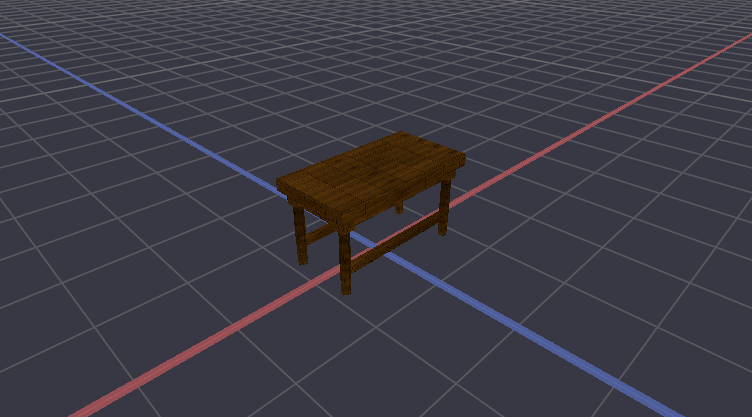
Example: “large wooden workbench with four legs”
Imagine describing an object and turning it into actual 3D geometry you can inspect, work on, and keep—not just another picture. That's what we're building with VeilForgeOS.
A standalone creation engine for assets and worlds. Early native examples already work; the full creative vision is still in development.
Creating 3D content often means juggling complicated steps and tools before you can even see your idea. VeilForgeOS is being designed to make that journey simpler—without taking away your ability to change the result.
Start with ordinary words instead of a blank modeling scene. Our early examples turn supported descriptions into structured 3D assets.
The goal isn't to give you a picture you can't change. It's to create meaningful parts, materials, and geometry you can inspect and refine in Studio.
Save your work, reopen it, and preserve the underlying structure. Deterministic construction helps make creation more consistent and verifiable.
Think of VeilForgeOS as a workshop built around your ideas. It aims to understand what an object is made of, build its real 3D parts, and keep those parts under your control.
Not dependent on Blender for its core workflow. The engine and Studio are being built as a standalone creation experience. External tools are for optional interoperability.
Explain what you want in everyday language: an object, its parts, size, relationships, and materials.
Turn supported descriptions into real mesh geometry and material assignments—not a static image.
Inspect the result in Studio. Expand native geometry, UV, material, and later character editing as development advances.
Save the authored asset. Reopen and validate its identity so work isn't lost in an opaque generation step.
These are genuine captures from VeilForgeOS development builds. They show working milestones, not finished production assets. We show them because progress should be visible and honest.
A recognizable table, four legs and supporting structure—created through the native Hero asset path. An early milestone, not a polished game-ready model.
Blade, crossguard, grip and pommel created and saved. The prototype's dark metal and basic grip show why material and detail quality are active priorities.
This is the actual Windows Studio application, with a native viewport, scene tools, and the Asset Foundry workflow. The interface is being redesigned for a larger viewport and cleaner workspace.
Real captures are self-hosted and unretouched. The interface and visual quality shown represent development builds, not a released product.
Different creators have different starting points. Our vision is a place where the idea comes first, while the result stays editable.
Build up a library of reusable props, structures, and eventually environments without repeating every step by hand.
Long-term benefit we're pursuingStart with organized geometry, then refine shapes, surfaces, and materials directly in a native editing workspace.
Advanced editing is in developmentTurn the places and objects you imagine into connected 3D scenes you can develop over time.
Broader world-building workflow is a goalHave a clear idea but don't know where to start in 3D? We want describing the goal to become a useful first step.
Accessible creation is a design goalWe'd rather be clear about what works than put future features behind a shiny “available now” label. Here's the difference.
These are specific demonstrated paths, not a promise that arbitrary prompts work.
These are priorities and ambitions, not shipped capabilities or release-date commitments.
We believe the future of 3D creation should combine the speed of describing an idea with the freedom of shaping it yourself.
VeilForgeOS is being built as its own engine and editor. Intelligent assistants are meant to propose changes with human approval—not quietly take control of your work. Authored geometry remains the source of truth; the rendered view is a result, not an uneditable black box.
No hype, no technical degree required.
Not yet. VeilForgeOS is in active private development. The screenshots show real internal development builds, not a public release.
No. Its purpose is to construct real 3D geometry, relationships and materials from supported descriptions. It is not simply creating 2D pictures. The range of prompts it understands is still limited.
The core workflow is being built to work in VeilForgeOS itself, with native Studio and Vulkan rendering. External 3D tools are intended only as optional export and validation companions, not requirements for core creation.
Native selection, transforms, authored documents and certain editing workflows exist. Deep topology, UV, advanced materials and character tools are still being developed. We won't label them finished before they are proven in Studio.
In simple terms: the engine is built to make results repeatable and checkable. The goal is to save a real creation, understand what produced it, and reconstruct the same outcome from the same inputs—not lose control after generation.
VeilForgeOS is being built independently, one verified piece at a time. If the vision matters to you, a voluntary donation helps support continued development.
You don't need to donate to follow the project. This is support for development—not a product purchase, preorder, membership, equity interest, or promise of early access.
Payment opens securely on PayPal. Review the recipient and final amount there before confirming. PayPal handles payment processing.